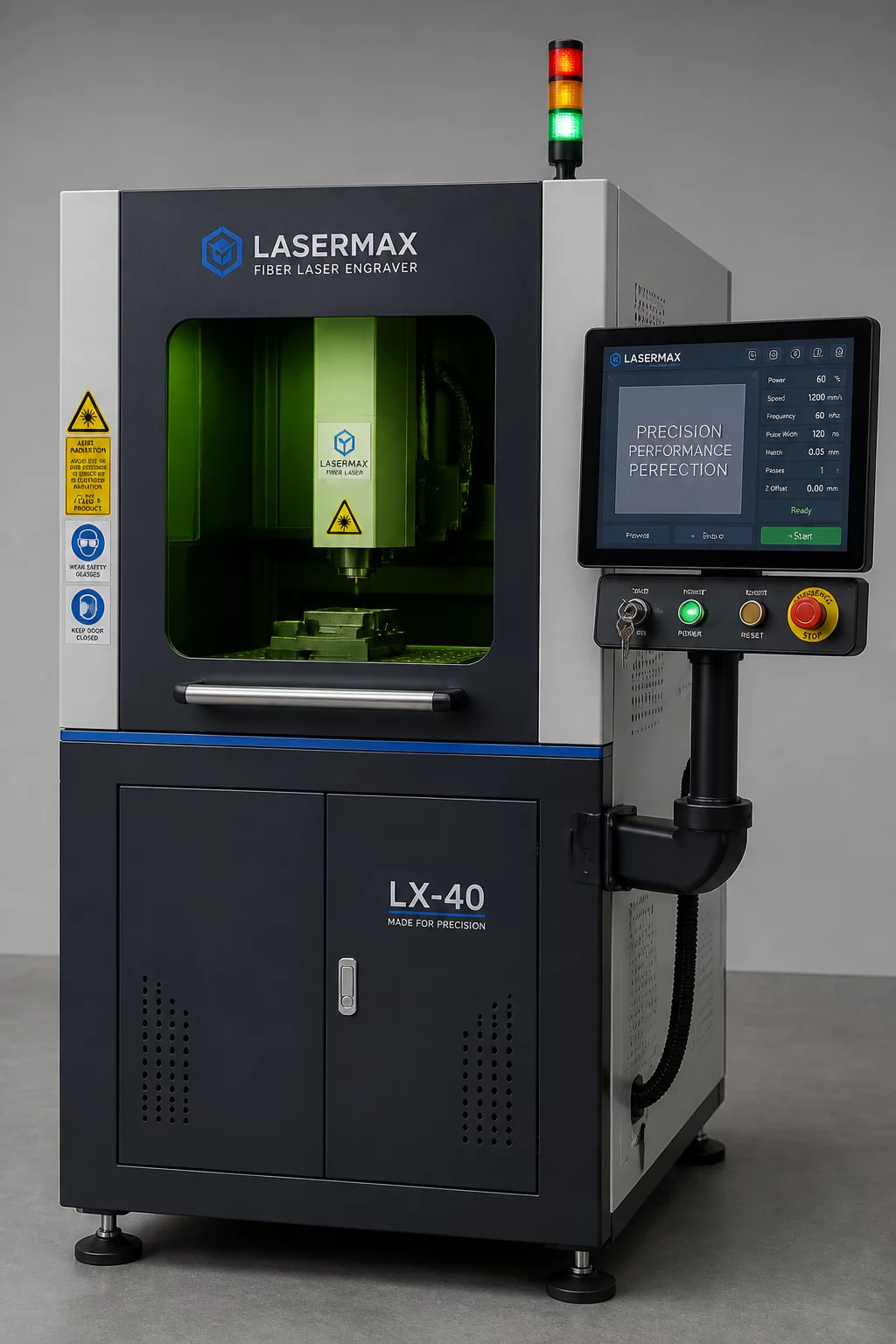
Key Factors in Industrial Laser Engraver Selection
Selecting the right laser engraver for an industrial production line requires a deep understanding of your substrate materials and cycle time requirements. A common mistake is buying a high-power fiber laser for organic materials, or a CO2 laser for direct metal engraving. In reality, wavelength determines material absorption. Fiber lasers operate at 1064nm, which is ideal for metals and hard plastics, while UV lasers (355nm) are perfect for damage-free marking on sensitive polymers and glass. CO2 lasers (10600nm) excel on wood, acrylic, paper, and glass. You need to analyze the absorption spectrum of your target material before deciding on the laser source.
Power, Frequency, and Pulse Width Optimization
Once the wavelength is selected, laser power and pulse parameters define the speed and quality of the mark. For metals, a 20W or 30W fiber laser is standard for high-contrast marking, while 50W to 100W sources are preferred for deep engraving and faster cycle times. Standard Q-switched lasers offer fixed pulse durations, whereas MOPA (Master Oscillator Power Amplifier) lasers allow adjustable pulse widths. This flexibility enables precise heat control, preventing warping in thin metal foils and allowing color marking on stainless steel. Frequency settings also play a critical role, as higher frequencies spread the pulse energy, leading to smoother surface finishes without deep penetration.
- Material Compatibility: Match the laser wavelength (Fiber, UV, or CO2) to the physical properties of the target substrate.
- Pulse Control: Select MOPA laser sources when working with heat-sensitive materials or when color marking is required.
- Integration Capabilities: Verify that the scanner head, software interfaces (like LightBurn or EZCAD), and input/output control lines align with your automation system.