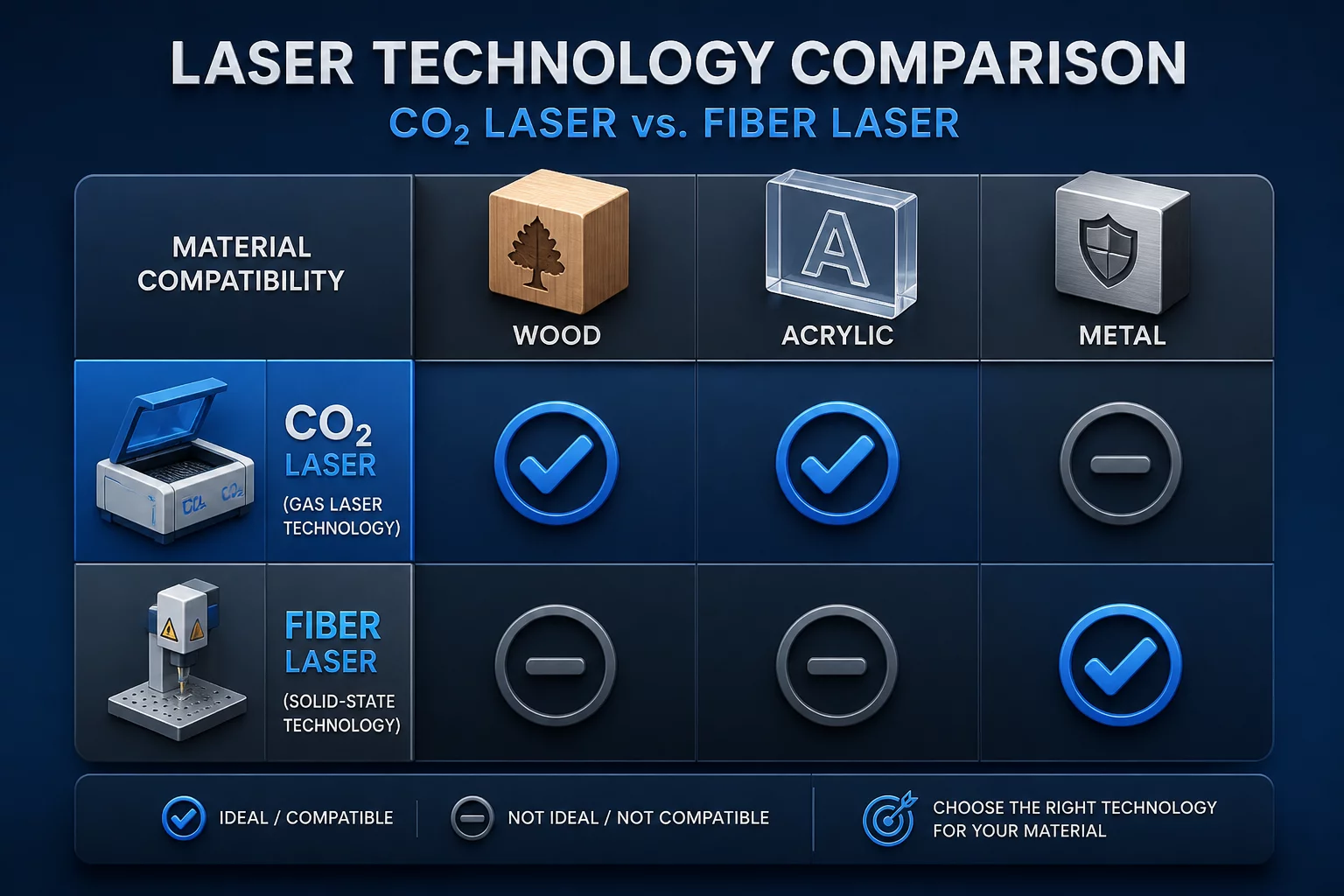
Empirical Laser Behavior on Industrial Materials
Laser applications in modern B2B manufacturing demand rigorous evaluation of energy distribution, thermal conductivity, and chemical absorption characteristics. Choosing the appropriate wavelength directly affects production throughput and surface integrity. Fiber lasers operating at 1064 nm deliver high peak power, which is ideal for metallic engraving and deep annealing. In contrast, CO2 lasers at 10.6 µm excel in organic materials, polymers, and glass. For heat-sensitive substrates, ultraviolet (UV) lasers at 355 nm use cold marking mechanisms to avoid micro-cracks and thermal distortion.
Operational Parameters and Selection Guide
To maximize marking contrast and maintain high structural durability, operators must calibrate laser settings to match the target material's physical properties. Adjusting the focal distance, raster step, and pulse width ensures optimal energy transfer without causing unwanted melting or vaporization of surrounding areas. These comparative metrics serve as an essential guide for integration teams designing high-speed inline manufacturing processes.
- Metallic substrates require fiber laser sources with high frequency range settings to achieve readable high-contrast Datamatrix codes.
- Highly sensitive polymers must be processed with ultraviolet systems to prevent melting along the boundary zones.
- Proper fume extraction and ventilation parameters must match the material density to protect the optical scanning components from particulate debris.