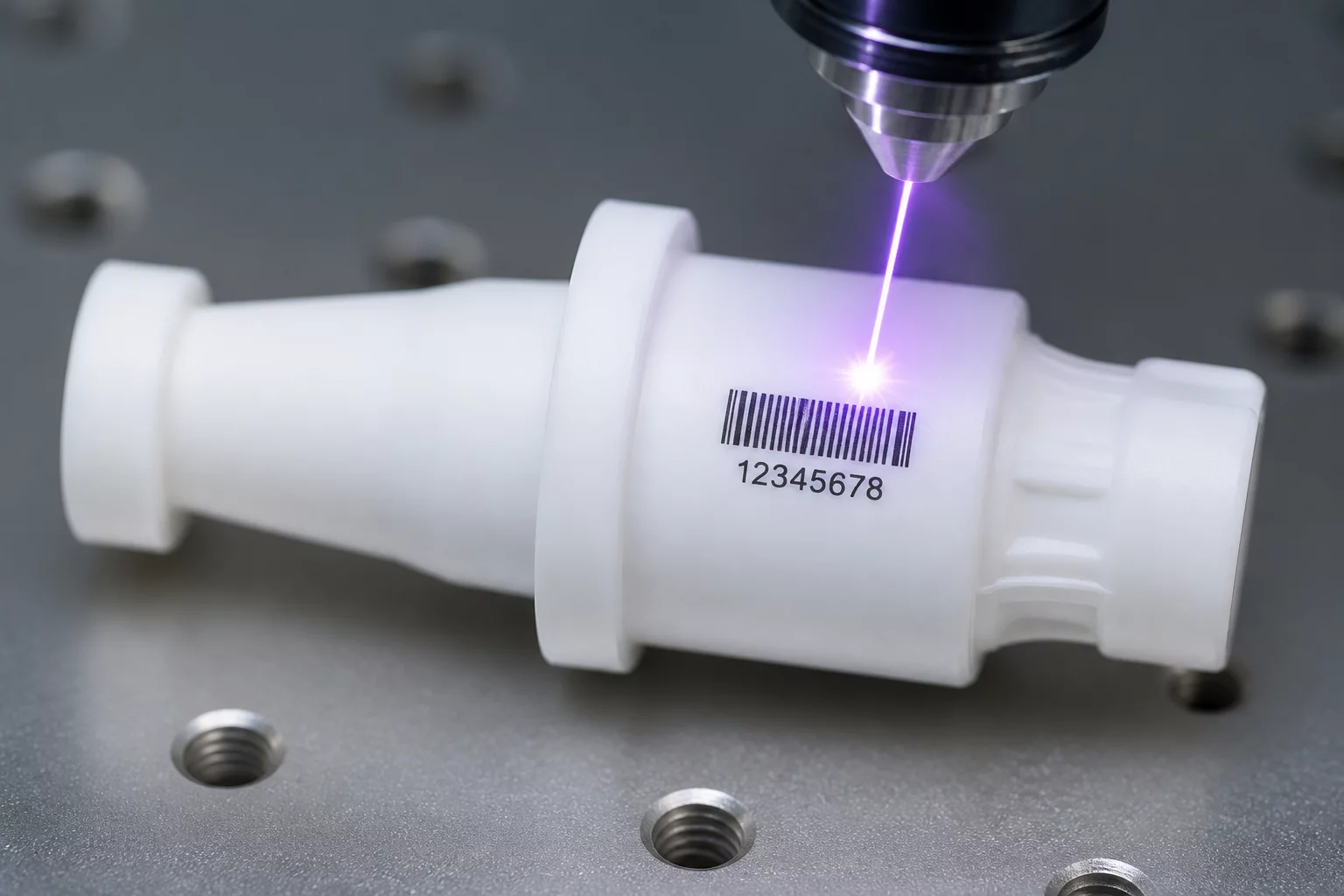
Subheading-1: Substrate Thermal Thresholds and Beam Absorption
Choosing the right laser source depends heavily on how the target material absorbs specific wavelengths. Fiber lasers operate at a 1064nm wavelength, making them highly effective for metals and hard plastics. However, sensitive organic compounds and medical-grade polymers risk thermal degradation under high-power infrared beams. To prevent melting, operators deploy ultraviolet (UV) lasers operating at 355nm, which rely on cold marking through photochemical interaction to disrupt molecular bonds without generating heat-affected zones.
Subheading-2: Optimizing Scan Parameters for Production Yields
To maximize output while keeping marks clean, you must balance scanning speed, pulse rate, and power density. Over-irradiating a surface results in micro-fractures, while under-powered passes lead to illegible codes. We recommend running systematic test grids on scrap material to identify the exact threshold where high-contrast marking occurs without compromising structural integrity.
- Map the absorption curve of each material to decide between UV, Fiber, or CO2 systems.
- Establish strict heat tolerance limits for thin-walled parts to prevent warping.
- Implement real-time focal distance calibration for curved or irregular surfaces.