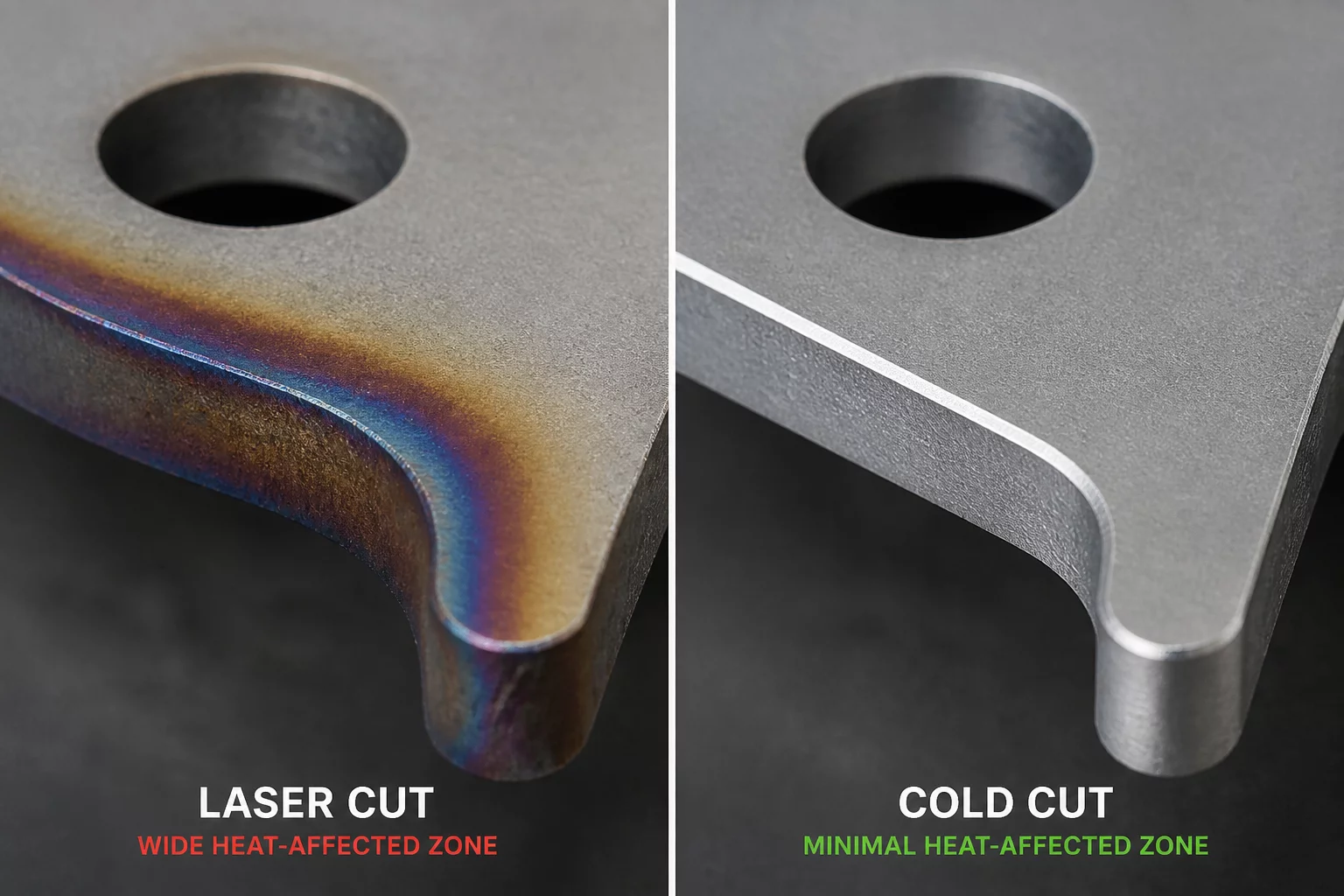
Photothermal Melting vs. Photochemical Cold Marking
Choosing the right laser wavelength is critical when working with thin foils, medical polymers, and heat-sensitive electronics. Fiber lasers emit near-infrared light at 1064 nm, inducing a photothermal reaction. This process rapidly heats the material past its vaporization point, which often leaves a noticeable heat affected zone (HAZ) characterized by micro-burrs, warping, or discoloration. On the other hand, UV lasers operate at 355 nm in the ultraviolet spectrum. Instead of relying on heat, UV lasers utilize high-energy photons to break chemical bonds directly at a molecular level. This photochemical process, commonly called cold marking, ensures clean results with almost no heat transfer to the surrounding structure.
Material Compatibility and Operational Benchmarks
Selecting the proper system depends on the material's thermal tolerance. Fiber lasers perform exceptionally well on heavy steel, anodized aluminum, and titanium, where deep engraving or high-contrast annealing is required. However, for sensitive substrates like glass, sapphire, or medical plastics, the high peak power of a fiber laser can cause micro-cracking or melting. UV lasers excel in these challenging scenarios, achieving high-contrast markings on fluoropolymers and delicate glass tubes. Understanding the threshold for heat dissipation prevents component degradation and guarantees structural integrity throughout the manufacturing cycle.
- Fiber lasers utilize 1064 nm wavelengths, causing thermal vaporization and leaving a moderate heat affected zone.
- UV lasers operate at 355 nm, breaking molecular bonds with minimal heat and zero discoloration.
- Delicate substrates like glass, polymers, and silicon require UV systems to prevent cracking or melting.
This could be your first comment.