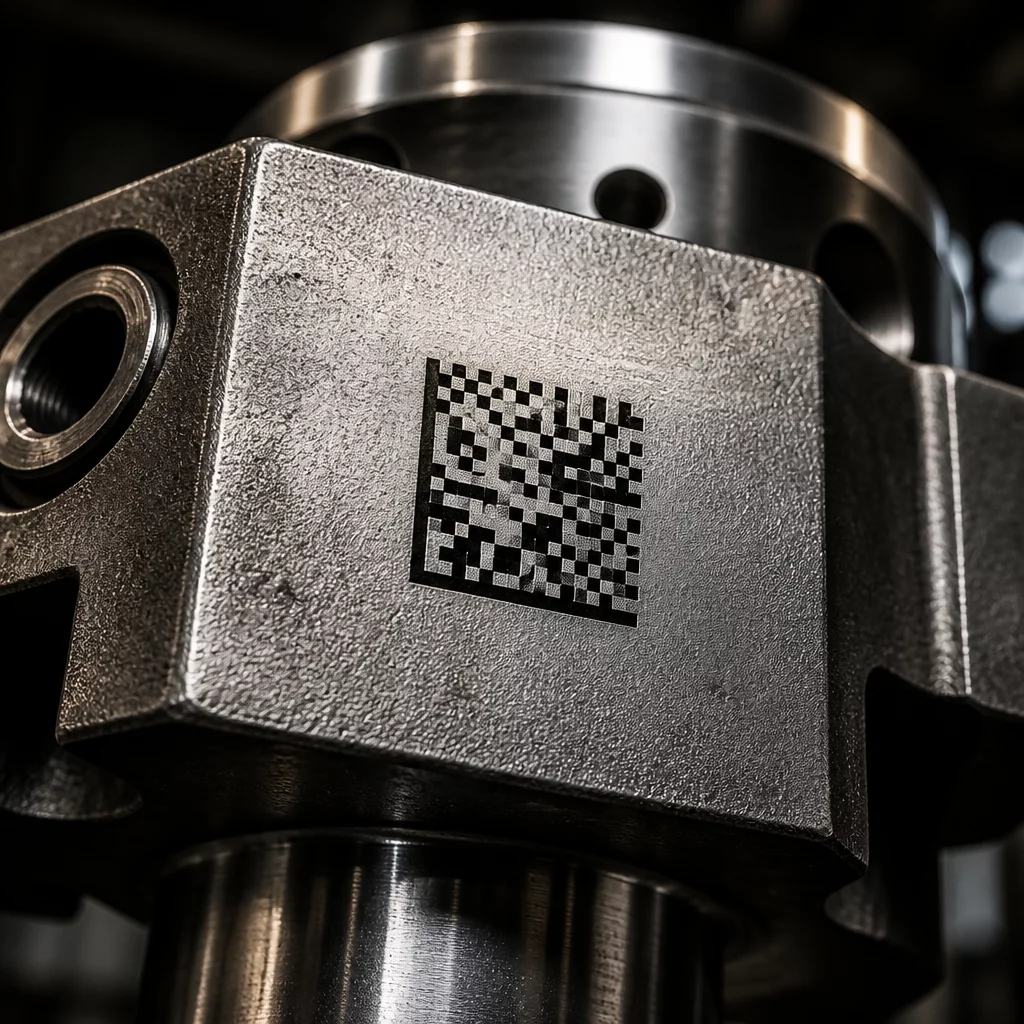
Principles of Deep Laser Engraving on Metals
Deep laser engraving physically removes material layers to create a permanent mark that resists wear, abrasion, and post-processing treatments such as sandblasting or painting. For industrial steel and aluminum parts, achieving a depth of 0.1mm to 0.3mm requires multiple rapid passes with a high-power fiber laser. The process relies on vaporizing the substrate while minimizing the heat-affected zone to prevent thermal warping. When configuring your fiber laser system, optimizing focal height and path overlap remains critical. By running a series of hatch angle changes between layers, operators eliminate trenching patterns and ensure a clean, flat bottom inside the engraved area.
Optimization Strategies for High Contrast DataMatrix Codes
A DataMatrix code must provide maximum readability for industrial scanners. High contrast is achieved by pairing deep, light-scattering dark cells with clean, reflective light cells, or by contrasting an oxidized dark mark against a polished metal surface. The optical scanner reads the difference in reflectance, meaning that surface roughness directly impacts the decodability grade. To achieve a crisp grade-A mark, operators must balance speed, frequency, and raster steps. Too much heat leads to cell bleeding, where the edges of adjacent modules blur together, rendering the 2D code unreadable.
- Power Modulation: Utilize MOPA lasers to control pulse duration and prevent thermal deformation on thin-walled metallic components.
- Multi-Pass Hatching: Apply orthogonal hatching patterns to clear material smoothly and prevent deep groove formation.
- Frequency Calibration: Set higher frequencies for surface cleaning and lower frequencies to achieve deep vaporization of steel.