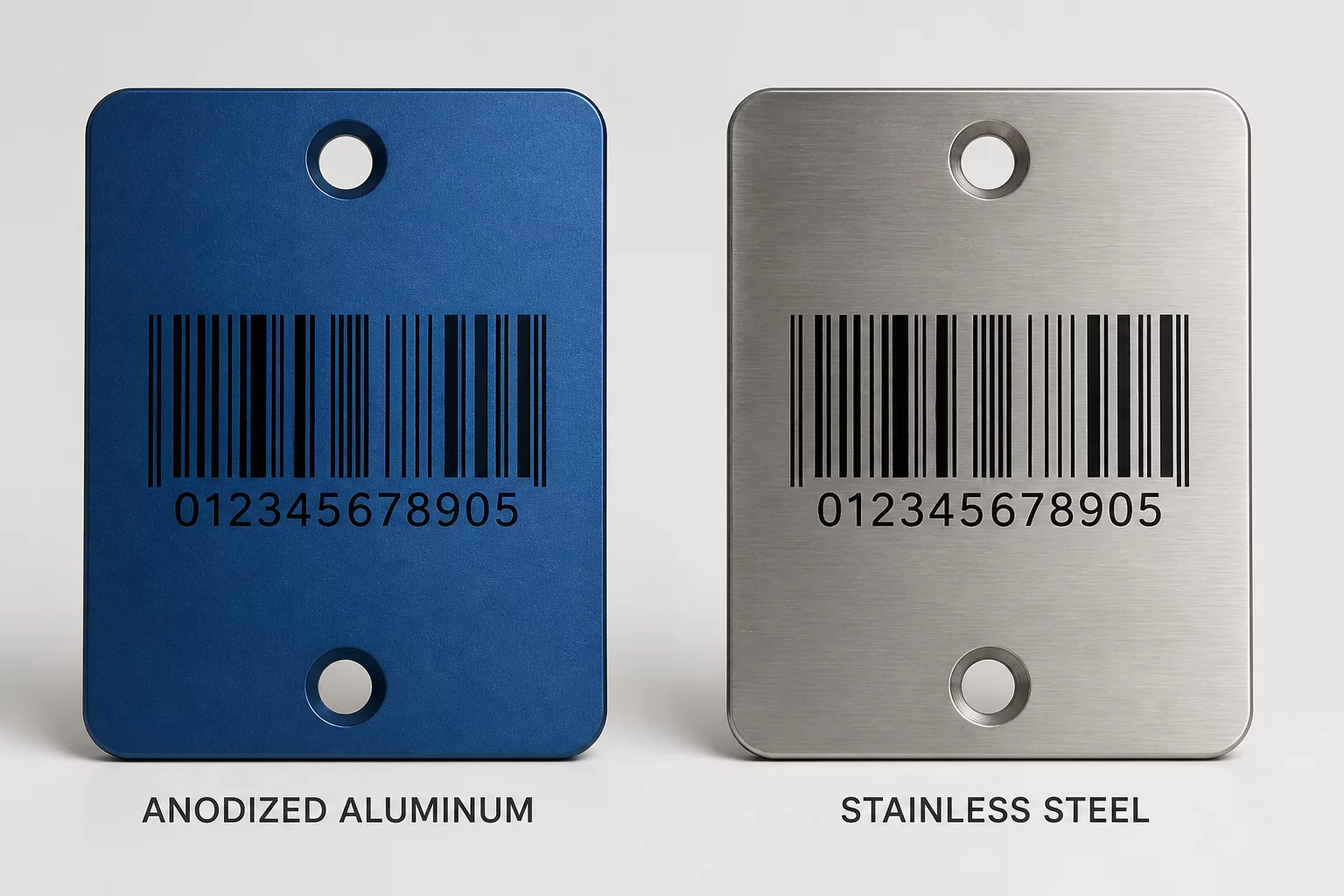
Two Materials Reacted Differently
Material-specific reactions required tailored parameter sets
2026-05-15
BY MarkOutcome Lab
MATERIAL ANALYSIS
1. Executive Overview
This case documents how two seemingly similar materials—both qualified for the same marking station—exhibited fundamentally different thermal responses under an identical parameter set. While initial process planning sought a unified program to accelerate deployment, empirical trials demonstrated that aluminum and untreated steel demanded distinct energy densities and temporal pulse shaping to achieve stable contrast, crisp edges, and reliable scan performance. The final outcome favored a split-profile strategy, enabling each substrate to meet target KPIs without compromising cycle time or inducing heat-related defects.
2. Systemic Challenges
Under the shared recipe, aluminum produced a high-contrast white mark with minimal melt. Conversely, the steel parts developed dark, uneven strokes accompanied by localized overburn and micro-pitting. The thermal conductivity and reflectivity deltas between the alloys shifted absorption dynamics, causing the energy per unit area to exceed the safe window on steel. Barcode cells on steel showed rounded corners and occasional bridging, eroding decode margins. Attempts to compensate by minor hatch tweaks failed to normalize the result; the fundamental energy coupling remained mismatched.
3. Comparative Trials
We executed a matrix of trials varying peak power, average power, frequency, and scan speed. Aluminum tolerated higher traversal speeds and benefited from slightly wider hatch to reduce dwell while preserving a bright surface reaction. Steel responded best to reduced peak power and a moderate frequency band that limited cumulative heating yet maintained stroke opacity. A short finishing pass cleared fines on both materials. Measured across 60 samples per condition, the tailored profiles improved scanner confidence from 93–95% up to 99%+ and eliminated rework on steel components.
4. Decision Rationale
Operations prioritized first-pass yield, stable decode margins, and surface integrity over the convenience of a single universal program. Separate LightBurn profiles were approved: the aluminum preset emphasized high scan speed with controlled overlap, while the steel preset leaned into reduced power density and a smaller spot-to-spot thermal footprint. The marginal overhead of maintaining two job files is offset by lower scrap, fewer hold tags, and less operator time spent polishing or re-running borderline marks.
5. Implementation Notes
Key procedural changes include explicit material selection at the HMI, parameter lockouts tied to the part traveler, and visual confirmation routines for the first article of each lot. For aluminum, we locked hatch angles to alternating 0°/90° with a mild finishing pass to remove any residual frost. For steel, we specified cross-hatch at lower overlap and codified a maximum allowable burr height under microscopy. Both profiles set minimum verifier grades and include a simplified escalation path if decode margins fall below thresholds.
6. Operational Impact
Following rollout, we observed a drop in rework events, consistent cosmetic outcomes across vendor lots, and improved scanner headroom—especially on the steel line. The revised approach underscores a common lesson in mixed-material environments: converging on one recipe can be a false economy when underlying physics diverge. Embracing material-tuned presets protects throughput and quality simultaneously, ensuring that “why one outcome was chosen” is backed by measurable process capability rather than subjective appearance.