Darker Was Not Better
Why darker appearance did not yield a better industrial outcome
2026-05-10
BY MarkOutcome Team
PRACTICAL CASE
1. Executive Overview
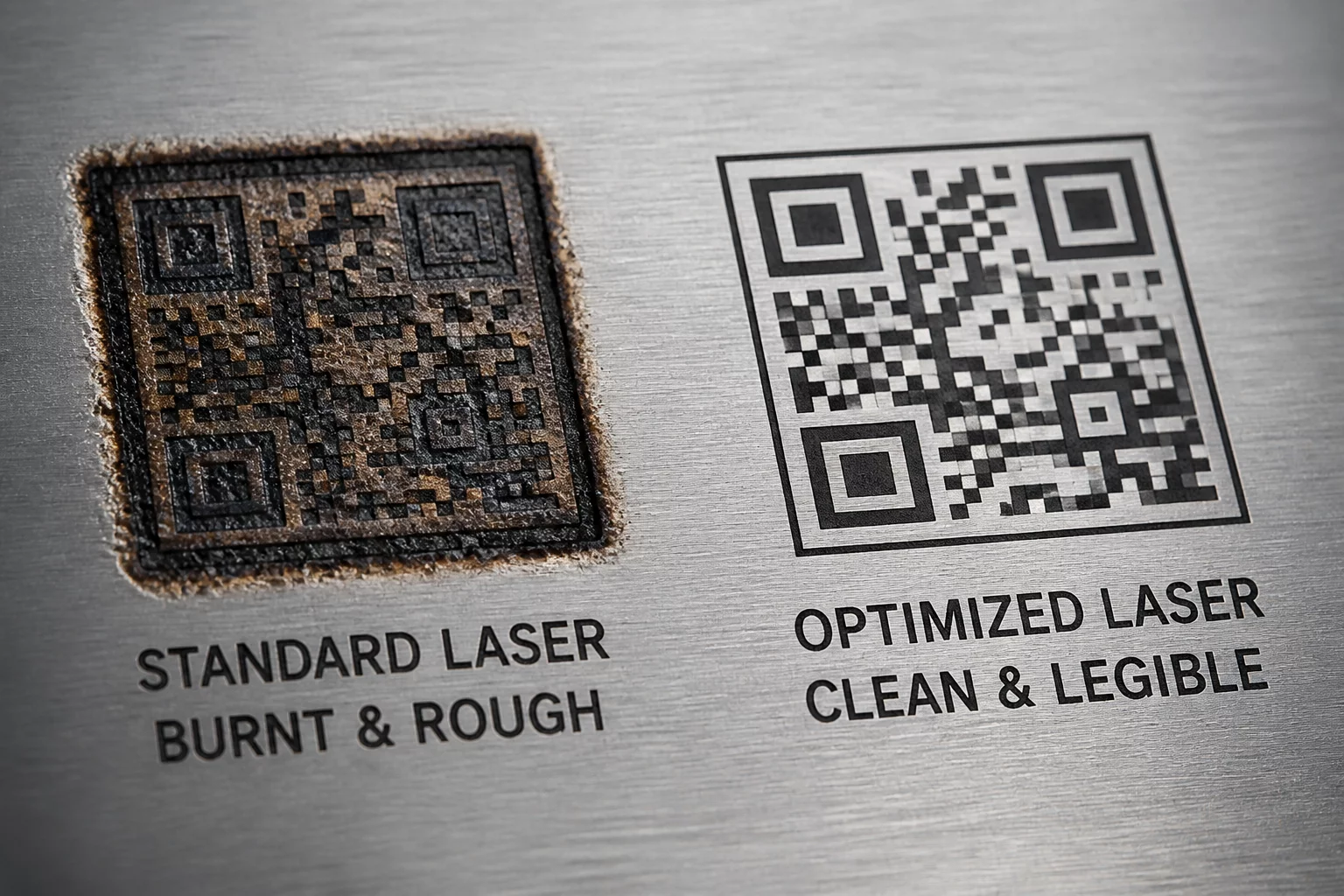
The intuitive preference for a darker mark often conflicts with the realities of precision manufacturing. While a deep, saturated tone may look appealing at first glance, it can mask thermal stress, edge deformation, and surface residue that undermine machine-vision performance and long-term legibility. In this study, we benchmarked a high-darkness recipe against an alternative tuned for edge integrity and stroke uniformity. Despite its lighter appearance, the second approach delivered higher scan success, fewer rework actions, and more stable part-to-part results, explaining why the team selected it as the final outcome.
2. Process Risks with Maximized Darkness
Maximizing darkness typically involves elevating energy density through higher power, slower speeds, or narrower hatch spacing. On metal substrates, this can trigger micro-cracking, molten lip formation, and slag accumulation—especially around tight radii and small DataMatrix cells. These artifacts do not merely affect cosmetics; they interfere with light reflection patterns and degrade barcode decode margins. Additionally, darker runs tend to increase cycle time due to post-processing (e.g., polishing or additional clean-up passes), which in turn elevates operator load and reduces line stability.
3. Comparative Trial Results
Across 100 sampled parts (50 per recipe), the darkness-first setup achieved compelling visual depth but suffered inconsistent scanner confidence (92–95%) and required manual touch-ups on roughly 10% of pieces to remove burr-like edges. Conversely, the cleaner-edge configuration—lower power, increased speed, and optimized hatch angle rotation—sustained a 99%+ scanner read rate across all lots, with no rework recorded. Under magnification, stroke edges remained sharp and uniform, and surfaces were free of thermal residue. The lighter tone posed no functional disadvantage: human-readable alphanumerics retained clarity, and 2D codes exhibited crisp cell boundaries essential for reliable decoding.
4. Decision Criteria
The cross-functional review board evaluated quality indicators in three categories: (1) inspection performance (verifier grade, scanner headroom, glare resistance), (2) mechanical cleanliness (burr height, slag presence, melt-zone width), and (3) operational efficiency (cycle time, rework incidence, operator interventions). The darkness-first recipe underperformed in categories (1) and (2) and increased (3), whereas the cleaner-edge recipe improved all three simultaneously. As a result, the team chose the cleaner-edge outcome, aligning with the Casebook’s guiding principle: the best marking outcome is the one that preserves edge integrity and process capability—not just the darkest tone.
5. Implementation Notes
To institutionalize the winning parameters, we embedded them in LightBurn project files and production travelers. Key changes included: (a) reducing peak power and slightly widening hatch spacing to limit heat input per unit area, (b) rotating hatch angles between passes to distribute residual energy and avoid directional banding, and (c) adding a final, very fast, low-power skim pass to clear fines and prevent raised edges. We also standardized stroke widths for alphanumerics to maintain stable energy coupling and set a maximum allowable burr height validated via profilometry. These instructions now accompany first-article checks for each lot.
6. Operational Impact
Within two weeks of adoption, first-pass yield increased, scanner false rejects declined, and cycle time improved due to the elimination of manual clean-up. Operators reported fewer exceptions and more predictable behavior across part geometries. Customer-facing reviews also noted a more professional finish—clean strokes and consistent line weight project precision, even if overall darkness is modestly reduced. The chosen outcome demonstrates that reliability, readability, and repeatability—backed by measured data—are superior predictors of success than visual boldness alone.
7. Lessons Learned
Darker is not inherently better. When in doubt, prioritize edge quality and scanner headroom. Small improvements in energy distribution often unlock outsized gains in verification metrics and operational stability. Future work will explore adaptive parameters tied to substrate lot data and ambient conditions to preserve these gains under variable inputs.